What Makes a Landscape Feel Vast in a Painting?
What makes a landscape feel vast in a painting? Learn how horizon placement, distance layers, and small figures help you read space with confidence.
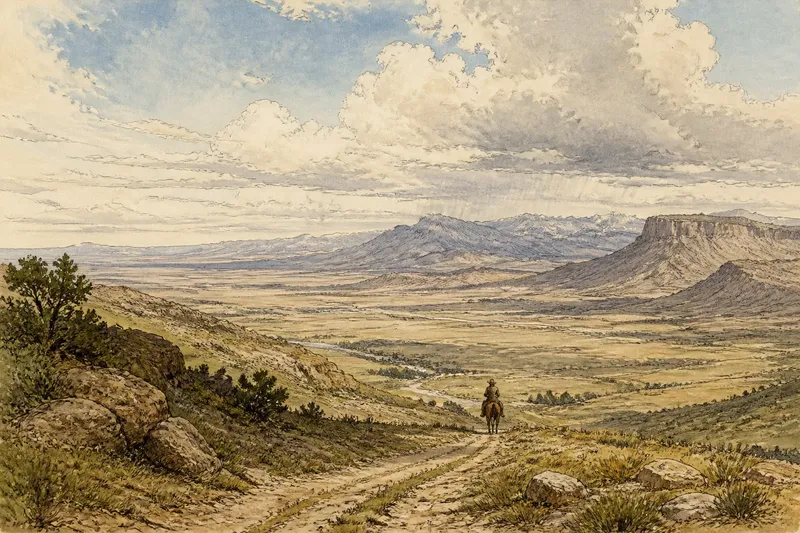
What makes a landscape feel vast in a painting? A tiny rider crossing a broad plain can make the land seem enormous, while a high horizon can press the same terrain close to the viewer. In Western landscape painting, vastness is not simply a matter of showing more scenery. It grows from cues that help your eye judge distance, scale, and your own imagined position in the scene.
Try looking at those cues in a short, deliberate routine rather than deciding at once that a painting is “big.” You can do it in a gallery, with a book, or while studying a reproduction at home. The point is to notice how the artist builds space, not to measure the scene as if it were a map.
Begin with the horizon
First, find where the land or water appears to meet the sky. The horizon is a useful anchor because its placement changes how much space the painting gives to ground and sky. A low horizon leaves a large field of sky above the land. A high one gives the foreground and middle distance more room in the frame.
Neither arrangement automatically feels more expansive. A low horizon can make the sky feel immense, especially if a cloud bank or subtle shift in color leads your gaze upward. A high horizon may make a plain feel broad by allowing a long stretch of foreground to unfold before the distant edge.
Look for the viewer’s implied eye level, too. If you seem to stand among grasses or rocks, nearby details may make the scene feel accessible and grounded. If the viewpoint seems elevated, the land may spread below you like a broad map. Ask where you would place your feet if you could enter the painting. That small question helps turn composition into a felt point of view.
Track the distance layers
Next, follow the land from the front of the picture toward the horizon. Many landscapes separate space into foreground, middle distance, and far distance. These do not need hard borders. A change in color, detail, overlap, or contrast can mark the shift.
- Foreground: Look for crisp edges, visible plants, rocks, paths, or other close details. These offer a scale reference and make the viewer feel near the ground.
- Middle distance: Notice where forms overlap or soften. A ridge partly hiding another ridge gives the eye a sequence to follow.
- Far distance: Check whether mountains, mesas, or plains lose sharpness and contrast as they recede. This atmospheric softening can suggest depth without drawing every distant feature.
Overlapping forms matter because the eye reads one shape in front of another as a spatial relationship. A line of foothills that partly covers a more distant range can create a clear passage into the scene. If every mountain edge sits separately against the sky, the view may feel flatter, even when the subject is a huge range.
Color helps, but it is only one part of the cue. Distant land may appear paler or cooler than nearby earth, yet an artist can also create depth through changes in edge, detail, and contrast. Notice whether several cues work together. When they do, the space is easier to imagine as something extending beyond the painted surface.
Use figures as scale cues
Small figures, cabins, wagons, fences, or livestock give the eye familiar points of comparison. Their value is not that they tell you the exact size of a mountain. Instead, they make the landscape’s proportions easier to sense. A person placed low in a broad valley can seem dwarfed by the terrain, while a cluster of buildings may make a plain feel inhabited and reachable.
Pay attention to where the figure sits. A person near the foreground can establish a human viewpoint. A tiny figure far away may serve as a visual marker that the open land continues well beyond the nearest slope. If the figure is isolated against a large area of ground or sky, the surrounding space can feel especially expansive.
But smallness alone does not create vastness. A tiny person in a tightly cropped scene may simply be far from the viewer. Look for supporting cues: broad intervals between landmarks, overlapping ridges, a receding path, or a horizon that seems to leave room beyond the frame. The figure works best as one part of a larger spatial arrangement.
Watch the eye’s route
After locating the main scale cues, trace the route your gaze takes. A river, wagon track, fence line, or chain of shadows may lead inward. Each bend or interruption can make the view feel deeper by inviting your eye to continue. A path that disappears behind a rise suggests terrain beyond what you can see; a road that ends abruptly at the frame can make the space feel bounded.
Imagine you are looking at a painted valley with a narrow track in front, a small rider near the middle, and overlapping ridges beneath a low horizon. Follow the track toward the rider, then notice how the ridges cover one another. You might expect the valley to feel deeper than a view with the rider centered against a single uninterrupted ridge, because the first arrangement gives your eye a route and several depth cues. That is a way to describe your reading of the picture, not a measurement of the real place.
Also notice what blocks the view. A near cliff, tree, or dark rock can act like a frame within the painting. It may make the distant opening seem farther away by contrast, or make the setting feel enclosed if it occupies too much of the composition. The question is not whether a foreground object is present, but what it lets you see beyond it.
What should you notice first?
Does a low horizon always feel more spacious?
No. It can enlarge the sky, but a broad and detailed foreground may carry much of the sense of scale when the horizon sits high. Notice which area receives the most visual room and whether the scene offers cues that lead your eye into it.
Why do distant mountains often look softer?
Reduced contrast and softened edges can suggest that air lies between you and the far range. The effect makes the mountains feel removed from the foreground, even if their outlines remain simple.
Can a landscape feel vast without people?
Yes. Overlapping landforms, a long view, changing detail, and a horizon with open space around it can suggest scale without a human figure. Look for another familiar reference, such as a tree, fence, or building, if one appears.
What if the painting feels flat?
Try checking for overlap and changes in edge, contrast, and detail from front to back. A scene may still feel intentionally flattened, but this close look can show which depth cues the artist has muted or omitted.
Finish with a second look
Return to the painting after tracing its horizon, layers, and scale cues. This time, ask what kind of presence the landscape gives you: are you standing inside it, looking down across it, or facing an opening you cannot enter? A painting can feel vast because it makes you imagine travel through the scene, but it can also make you feel like a small observer before an immense view.
For a useful final note, name the cue that did the most work for you and one that changed your first impression. Perhaps the sky first seemed dominant, until the tiny cabin made the plain feel wider; perhaps a high horizon initially felt restrictive, until a winding track pulled your eye through the foreground. Keep those observations in mind when you next ask what makes a landscape feel vast in a painting: scale emerges from relationships, and the most persuasive ones are often visible in the way your eye moves.