The Sketchbook as an Artist’s Working Space
A sketchbook as an artist’s working space can turn quick observations into useful composition tests while keeping unfinished ideas ready to revisit.
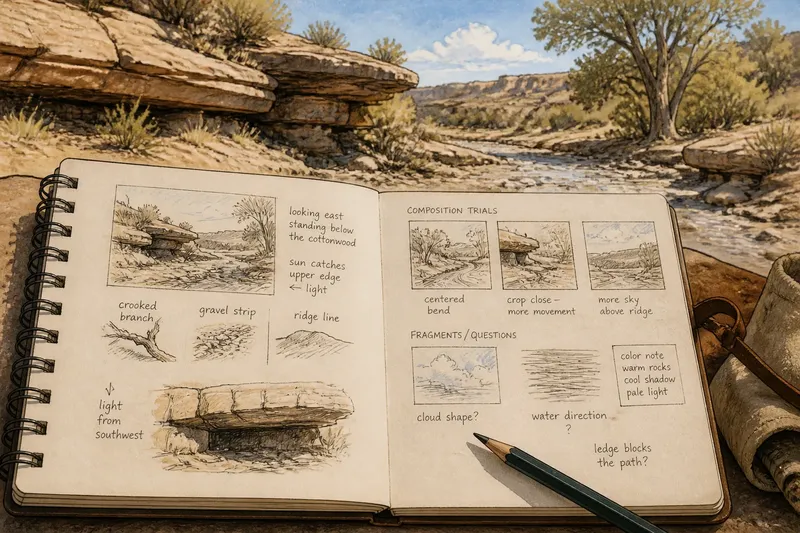
What is a sketchbook for when its pages are rough, crossed out, or only half used? A sketchbook as an artist’s working space is less a collection of finished pictures than a place to notice, compare, and leave questions open. Imagine a painter visiting a dry creek bed in the American West with a small spiral notebook, a soft pencil, and no plan to make a finished landscape that afternoon. The pages can still help the painter see what the scene offers.
A place to notice
At the creek, the painter first records observations rather than trying to draw the whole view. A few short lines might mark the creek’s bend, the shelf of rock above it, and the dark gap beneath a ledge. A note such as “sun catches upper edge” can preserve a change in light that a quick drawing cannot explain on its own.
These marks are useful because they separate looking from composing. The painter can record a feature without deciding yet where it belongs in a picture. A thumbnail of a crooked branch, a strip of gravel, or a distant ridge may later serve as a visual reminder, even if the page looks plain.
It helps to include context beside the drawing. Write “looking east” or “standing below the cottonwood,” or add an arrow to show the direction of the light. Such notes are modest, but they make the page easier to read after the immediate scene has passed. The sketchbook becomes a record of attention, not a test of drawing skill.
Testing the frame
Once the painter has gathered a few observations, the notebook can hold several small composition trials. In the invented creek-bed visit, the painter draws three boxes no larger than postage stamps. One places the bend near the center; another crops it close; a third gives more room to the open sky above the ridge.
Small boxes keep the question manageable. Instead of rendering every stone, the painter asks what should lead the eye and what can stay quiet. A thick pencil line can stand for the rock shelf, while a blank patch marks the brightest area. The goal is not a miniature masterpiece. It is to make choices visible enough to compare.
Those alternatives reveal different possibilities in the same place. A centered bend may feel settled, while a cropped bend can suggest movement beyond the page. The painter need not choose a winner on the spot. A brief note—“try more sky” or “ledge blocks the path”—records what each version is testing.
Leaving ideas unfinished
A sketchbook also gives incomplete thoughts somewhere to wait. On this visit, the painter might draw the outline of a cloud, then stop before filling in its shadows. On the next page, a loose set of parallel marks could suggest the water’s direction without describing its surface. These fragments are not failed pictures. Each keeps one question available for later.
Leaving space around a fragment matters. A blank margin can hold a later color note, a change of viewpoint, or a reminder that the creek looked different under cloud. The painter can return to the page without pretending to remember exactly what was seen. That honesty helps: a sketchbook can distinguish direct observation from an idea added afterward.
Not every unfinished thought deserves development. Some can remain small, serving as useful records rather than promises of future paintings. A page may contain a good silhouette but no compelling composition. Another may preserve a color relationship that could be borrowed for a different subject. Keeping these roles separate allows the notebook to stay open-ended.
Reading the pages later
Back in the studio, the painter turns through the creek-bed pages and finds three kinds of material: observations, composition trials, and fragments. The notes about light help identify which marks came from the visit. The little boxes make it easy to compare framing. The incomplete cloud and water marks offer details that can be reconsidered without copying the scene wholesale.
Say the painter wants to develop the version with more sky. The next move might be to make a larger drawing on loose paper, using the sketchbook’s ridge line and light note while changing the creek’s bend. The sketchbook has supported the decision, but it does not dictate the finished image. That distinction keeps observation from becoming a rigid template.
A useful page often makes its purpose legible at a glance. The painter can circle a promising thumbnail, cross out an option that no longer seems useful, or add a short question beside an unresolved fragment. These marks are part of working, not damage to a display object. If a page feels cluttered, a small label such as “shape study” can clarify what the painter was exploring.
Questions artists ask?
What should go in an artist’s sketchbook?
Include quick drawings, visual notes, small composition trials, and fragments worth revisiting. A date or location note can help identify the circumstances behind an observation.
Do sketchbook drawings need to look finished?
No. Their value can lie in recording a shape, relationship, or question clearly enough to use later. A rough mark that captures the creek’s bend may be more useful than careful shading that obscures it.
How can I use a sketchbook for composition?
Draw several small frames and vary one choice at a time, such as the crop or the placement of the horizon. Compare what each version emphasizes before enlarging a preferred arrangement.
Should I keep pages that do not work?
Usually, a page can remain as a record of what you considered, even if you do not pursue its idea. If a mark or note becomes confusing, add a brief explanation rather than trying to make the page look finished.
A working record
The imagined visit ends with no polished creek painting, but the notebook holds more than a memory of the place. It contains observed details, competing frames, and unfinished marks that can be carried into later work. That is the practical strength of a sketchbook as an artist’s working space: it lets an idea stay provisional while giving the artist something specific to return to.
For your next outing, choose one modest question before you open the notebook: where does the light catch, what shape carries the view, or how does a tighter crop change the scene? Record what you see, then leave room for the answer to shift. A sketchbook earns its place not by looking complete, but by helping the next decision become clearer.